
Digital accountancy support for private hire drivers:
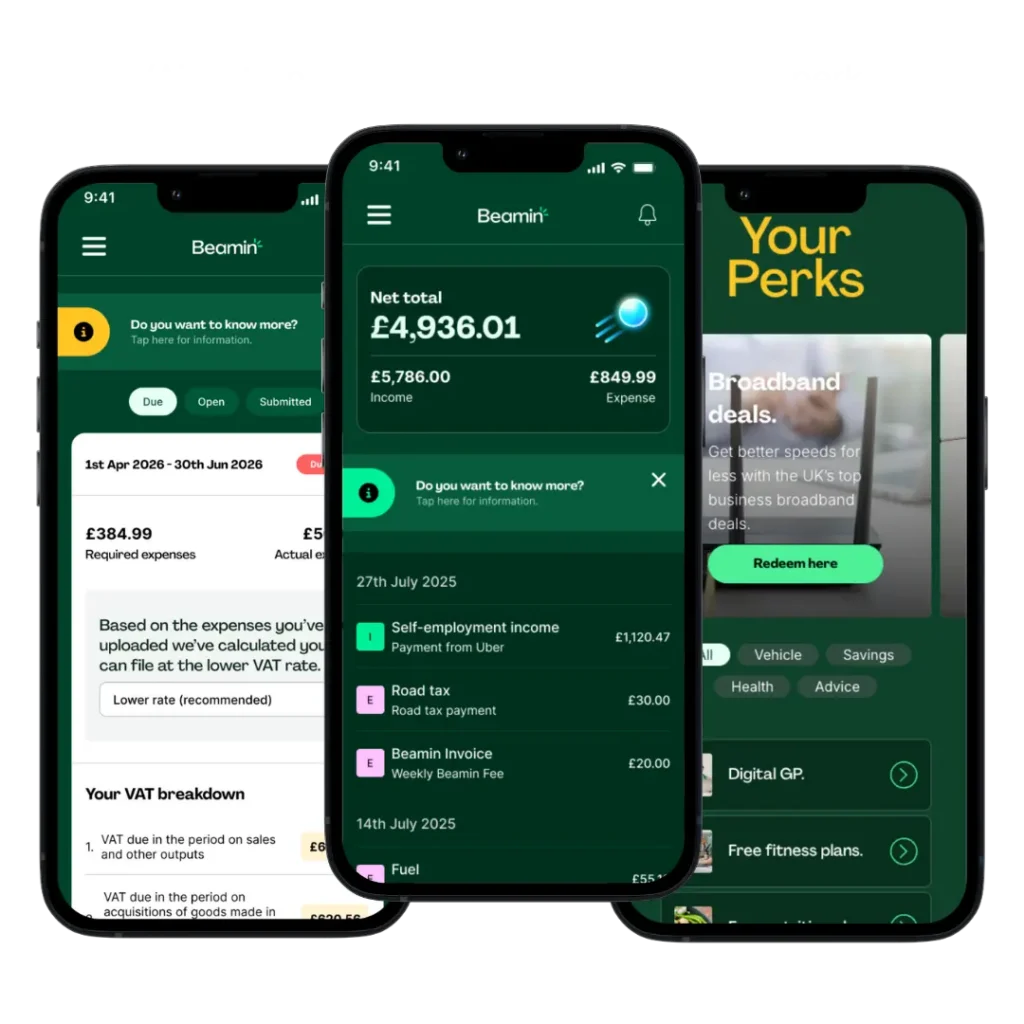




VAT registration service for drivers using Bolt, when they pick an eligible Beamin product:
The terms of the Bolt & Beamin offer are available here.
The content on this page is for general information. Beamin can advise drivers on their personal tax position.
After providing your name and contact information, Beamin will share them with Bolt for the purpose of eligibility confirmation.
Further information can be found in our privacy policy. The terms of the Bolt & Beamin offer are available here.
Tick off taxes and ditch accountancy headaches through Beamin.
Tick off taxes and ditch accountancy headaches through Beamin.
From April 2026, HMRC is introducing Making Tax Digital, bringing important changes for sole traders.
If your total income exceeds £50,000 in the 2024/25 tax year, you’ll be required to submit quarterly summaries of your income and expenses.
Your first update will cover April to June 2026, and must be submitted by 7 August 2026.
This is in addition to your annual Self Assessment tax return, making it more important than ever to keep your records accurate and up to date.
At Beamin, we know that managing tax and VAT responsibilities can feel overwhelming. That’s why we take care of your full quarterly reporting for you.
We ensure everything is tracked, organised, and ready for submission – keeping all your income and expenses in one place.
Benefit from our user-friendly app and accountancy support to manage your self-assessment and VAT registration. Get ahead of your MTD requirements with Beamin and feel confident that you’re 100% compliant with HMRC.
We handle your complete VAT application to HMRC from start to finish. This takes the stress and confusion of doing it yourself.
Our team understands the VAT requirements that drivers using Bolt face, so we always make sure your application is submitted 100% correctly in line with HMRC rules.
Drivers using Bolt do not need to register for VAT, unless your taxable income is above the £90k threshold.
However, you can still register for VAT regardless, as it can be incredibly advantageous for you depending on your tax circumstances.
You have two options as a driver using Bolt, standard rate and flat rate. The Flat Rate VAT scheme is a simplified method for managing and filing VAT returns and we find many drivers opt for this scheme due to ease.
If you decide to register for VAT, the fares you receive through the Bolt platform will include VAT. This means VAT is added on top of your usual earnings rather than taken out of your income.
From April 2026, HMRC is introducing Making Tax Digital, bringing important changes for sole traders.
If your total income exceeds £50,000 in the 2024/25 tax year, you’ll be required to submit quarterly summaries of your income and expenses.
Your first update will cover April to June 2026, and must be submitted by 7 August 2026.
This is in addition to your annual Self Assessment tax return, making it more important than ever to keep your records accurate and up to date.
At Beamin, we know that managing tax and VAT responsibilities can feel overwhelming. That’s why we take care of your full quarterly reporting for you.
We ensure everything is tracked, organised, and ready for submission – keeping all your income and expenses in one place.
Benefit from our user-friendly app and accountancy support to manage your self-assessment and VAT registration. Get ahead of your MTD requirements with Beamin and feel confident that you’re 100% compliant with HMRC.
We handle your complete VAT application to HMRC from start to finish. This takes the stress and confusion of doing it yourself.
Our team understands the VAT requirements that Bolt drivers face, so we always make sure your application is submitted 100% correctly in line with HMRC rules.
Bolt drivers do not need to register for VAT, unless your taxable income is above the £90k threshold.
However, you can still register for VAT regardless, as it can be incredibly advantageous for you depending on your tax circumstances.
You have two options as an Bolt driver, standard rate and flat rate. The Flat Rate VAT scheme is a simplified method for managing and filing VAT returns and we find many drivers opt for this scheme due to ease.
If you decide to register for VAT, Bolt will pay your fares for you, including VAT. This means it will not be taken out of your income, but added on top of your usual earnings instead.
An average driver earns £2000 per month. Tell us how much you expect to earn and we'll tell you how much extra income you could have.
£1000
* If you earn £750 or below per month you won't benefit from the Flat Rate VAT scheme and it will impact your income. These calculations are subject to eligibility and meeting the qualification criteria.
monthly VAT pot
80.00
extra per month
subject to admin fees
annual VAT pot 960.00
Beamin is a digital tax platform built specifically for self-employed drivers and contractors. It’s designed to make managing your earnings simple, clear, and rewarding.
Through Beamin, drivers can register for VAT, keep their income and expenses organised, and submit VAT returns and tax filings using HMRC-approved, Making Tax Digital (MTD) compliant software. The platform is built around how drivers actually work, with simple uploads, clear figures, and guidance where it’s needed.
We combine HMRC-approved digital software with a team of experts that understands ride-hailing and delivery income, VAT schemes, and the rules that apply to drivers. That means clearer figures, fewer mistakes, and less time spent trying to work things out yourself.
Once you’re VAT registered, the fares you receive through the Bolt platform include VAT. This means 20% VAT is added on top of your normal income and passed on to you through the platform, for you to pay to HMRC yourself.
With this, you’ll then be able to benefit from the Flat Rate VAT Scheme to your VAT. You’ll pay HMRC a fixed percentage of your VAT-inclusive turnover (9% in year one, 10% each year after), and keep the difference in VAT added to your fares and VAT paid to HMRC.
If you are not VAT registered, VAT is effectively included in what you’re paid, so there is no extra amount added on. By registering, VAT is handled separately and then paid to HMRC later, which can put you in a better financial position depending on the VAT scheme you use.
VAT registration also becomes mandatory once your income reaches £90,000 in a 12-month period. This is based on your gross income before expenses, which is a very common mistake drivers make. Many drivers assume the threshold is based on their profit, but HMRC looks at the turnover.
Registering earlier helps make sure everything is set up correctly from the start, avoids last-minute issues if you approach the threshold, and reduces the risk of errors or penalties later on.
Once you are VAT registered, the fares you receive through the Bolt platform include VAT. This means 20% VAT is added on top of your normal income and passed on to you through the platform, rather than coming out of what you earn.
If you use the Flat Rate Scheme, you then pay HMRC a fixed percentage of your VAT-inclusive turnover – 9% in your first year and 10% thereafter – and keep the difference. For many drivers, this can result in a net financial benefit.
Alternatively, if you use the Standard VAT Scheme, you charge VAT on your income through Bolt and can reclaim VAT on eligible business expenses, such as vehicle costs and other VAT-able purchases.
Flat Rate VAT is a simplified way of accounting for VAT that is well suited to many self-employed drivers.
Instead of tracking and reclaiming VAT on every individual expense, you charge VAT on your fares as normal and then pay HMRC a fixed percentage of your VAT-inclusive turnover. For drivers, this is typically 9% in the first year and 10% thereafter.
You keep the difference between the VAT you charge and the amount you pay to HMRC, which reduces admin and can result in a net financial benefit where your VAT-able expenses are relatively low.
This is why the Flat Rate Scheme is often the most suitable option for drivers working through ride-hailing platforms.
The Flat Rate Scheme is often a good fit for drivers because it makes VAT much simpler and quicker to manage. Instead of tracking VAT on every expense, keeping detailed records, and working out how much VAT you can reclaim each quarter, you simply pay HMRC a fixed percentage of your turnover. This means fewer calculations, fewer receipts to worry about, and less time spent on admin.
It also reduces the risk of mistakes, makes your VAT bills more predictable, and frees up your time so you can focus on driving rather than paperwork. For many drivers with relatively low VAT-able expenses, it’s a more practical and straightforward way to manage VAT.
This example is for illustration only and uses simplified assumptions. Your actual income, expenses, and VAT position may be different.
HMRC introduced the “limited cost business” rules to prevent businesses with very low costs from benefiting unfairly from the Flat Rate Scheme.
Under these rules, a business is classed as a limited cost business if it spends very little on goods.
If you are a limited cost business, you must use the higher Flat Rate percentage of 16.5% instead of the standard Flat Rate percentage for your sector.
You are treated as a limited cost business if, in a 12-month period, you spend less than the higher of:
If you meet either of those conditions, the 16.5% Flat Rate must be used.
Examples that do count as relevant goods:
The following do not count as relevant goods for the limited cost business test:
These are treated as services, even if they are business expenses.
The Flat Rate Scheme is a simple way to manage your VAT. Instead of tracking and reclaiming VAT on every individual expense, you pay HMRC a fixed percentage (9% in the first year, 10% thereafter) of your VAT-inclusive turnover and keep the difference between the VAT you charge and the amount you pay over. This reduces admin and makes your VAT easier to manage, which is why it works well for many self-employed drivers.
Under the Standard VAT Scheme, you calculate VAT in more detail. You charge VAT on your income, reclaim VAT on eligible business expenses, and then pay HMRC the difference between the VAT you’ve charged and the VAT you’ve reclaimed. This can be beneficial if you have high VAT-able costs, but it requires more record-keeping and ongoing administration.
However, many common driver expenses – including insurance – do not include VAT and cannot be reclaimed, which limits how much VAT can typically be recovered under the Standard Scheme.
In some cases, HMRC may contact both you and Beamin to request additional information before completing your VAT registration. If this happens, there’s no need to worry.
We’ll respond to HMRC with the information we already have, and if anything further is required from you, we’ll let you know clearly and promptly. Requests for additional information are common and do not mean there is a problem with your application
No. Beamin will only apply to register drivers for VAT if they are actively using the Bolt platform at the time the application is submitted. If you are not currently using the platform, your VAT registration will not be processed until your Bolt account is active.
Yes. If your circumstances change and you feel that a different VAT scheme would be more suitable, it is possible to change schemes.
If you choose to use Beamin’s VAT or full service, we can contact HMRC on your behalf to request the change and guide you through the process.
Most VAT-registered businesses submit VAT returns quarterly.
Each return – and any VAT due – must be submitted and paid to HMRC by one month and 7 days after the end of your VAT period.
For example, if your VAT period ends on 31 March, your VAT return and payment are due by 7 May.
HMRC will confirm your VAT periods and deadlines once your registration is complete.
For details of how to pay your VAT bill, please follow the link: Pay your VAT bill
If you use Beamin’s VAT or full service, we’ll take care of preparing your VAT return for you. You simply upload your income and expense receipts to Beamin, and we use our picture-scanning technology to extract the relevant information and calculate your VAT figures accurately.
Once your VAT return is ready, you can submit it directly through Beamin using HMRC-approved, Making Tax Digital–compliant software. We’ll clearly show you the figures being submitted, along with how much VAT is due and when it needs to be paid.
Without Beamin, you would need to manually track your income and expenses, enter figures into separate software, calculate VAT yourself, and make sure everything is submitted correctly and on time – a process many drivers find time-consuming and difficult to manage alongside driving.
HMRC requires you to keep records of:
These records must be kept digitally and retained for at least 6 years.
When you use Beamin, you can upload your income and expense receipts in one place, helping you keep the records HMRC expects without needing to manage spreadsheets or paper files.
Under the Standard VAT Scheme, you can reclaim VAT on eligible business expenses that include VAT.
Common examples include:
Many common driver costs – such as insurance do not include VAT and cannot be reclaimed.
If you use the Flat Rate Scheme, you generally do not reclaim VAT on individual expenses, as VAT is accounted for using a fixed percentage instead.
No. Although Bolt provides earnings information, you remain responsible for submitting your VAT returns and paying any VAT due to HMRC.
Bolt does not submit VAT returns or make VAT payments on your behalf. Your VAT obligations must still be met through your own VAT account and Making Tax Digital–compliant software.
If you earn income outside of the Bolt platform, it may still need to be included in your VAT returns, depending on the type of income. In many cases, VAT will need to be charged on that income and reported to HMRC alongside the income you earn through the Bolt platform.
Examples of income that may need to be included are:
Some types of income are not VATable and do not need to be included in your VAT returns. For example:
If you miss a VAT submission or payment deadline, HMRC may charge late filing penalties, late payment penalties, and interest.
HMRC now uses a points-based system for late VAT submissions, meaning repeated missed deadlines can lead to fines even if no VAT is owed. Paying and submitting on time helps avoid unnecessary charges and follow-ups from HMRC.
Using a system that keeps your records organised makes it much easier to stay on top of deadlines.
Not registering for VAT voluntarily
Some drivers delay registering even when it would be beneficial. In many cases, VAT can be added on top of fares and passed through the platform, meaning registering earlier can improve cash flow rather than reduce take-home.
Using the wrong VAT threshold figures
The VAT registration threshold is based on your gross income before deducting business expenses. This is one of the most common and costly misunderstandings.
Missing the Flat Rate Scheme first-year discount
Drivers who don’t register correctly or at the right time can miss the 1% Flat Rate Scheme discount available in the first year, which can make a noticeable difference to the VAT you pay.
Trying to mix VAT accounting methods
HMRC does not allow you to use more than one VAT accounting method at the same time. For example, you cannot combine mileage claims with actual expense claims, or mix Flat Rate and Standard VAT rules.
Assuming all expenses include VAT
Many common driver costs – such as insurance, vehicle rental, and platform fees – do not include VAT and cannot be reclaimed, which can make the Standard VAT Scheme less beneficial than expected.
If you’re self-employed, you’ll usually need to submit a Self Assessment tax return to HMRC each year to report your income and pay any tax due.
This applies even if you’re registered for VAT and submitting VAT returns separately — VAT returns do not replace your annual tax return.
If you also have other income, such as PAYE employment, this may still need to be included on your tax return, depending on your circumstances.
If you choose to use Beamin’s Tax or full service, our platform can help you organise your income and expenses throughout the year and make the Self Assessment process much simpler.
If you don’t declare your income correctly, HMRC can charge penalties, interest, and backdated tax.
It’s important to know that platforms like Bolt are required to report information about drivers’ earnings to HMRC.
Declaring your income accurately from the start helps avoid problems later and keeps everything straightforward and stress-free.
If you use Beamin’s Tax or Full Service, our platform helps you keep your records organised and makes it much easier to report the correct figures to HMRC.
Making Tax Digital for Income Tax (often called MTD ITSA) is a new HMRC requirement that changes how self-employed individuals report their income and expenses.
From April 2026, MTD ITSA will apply to self-employed individuals and landlords with qualifying income of £50,000 or more. Instead of submitting one Self Assessment tax return each year, you’ll be required to:
These quarterly updates are not tax bills – they are summaries that help HMRC build a clearer picture of your income during the year. You’ll still submit a final declaration after the end of the tax year to confirm your total income and tax due.
Beamin is HMRC-approved MTD software. If you choose one of our Tax or full service products, you can use Beamin to manage your income and expenses in one place. Simply upload your records, and our software will organise the data and populate your returns, making it easy to stay compliant and submit everything digitally to HMRC.
MTD ITSA is a significant change, but with the right software in place, it doesn’t need to be complicated.
When checking whether Making Tax Digital for Income Tax (MTD ITSA) applies to you, HMRC looks at your total qualifying income, not your profit.
This means you must use your gross self-employed income before expenses, not the amount you’re left with after costs. Using profit figures is a very common mistake and can lead to MTD applying earlier than expected.
You should also make sure you’re including the right types of income. MTD ITSA applies to qualifying self-employed and property income, but does not usually include PAYE salary or wages.
Using the wrong figures can result in missing the point at which MTD becomes mandatory, which may lead to compliance issues later on.
If you choose to use Beamin, our platform and team can help you understand what income should be included when assessing whether MTD applies to you.
If you’re not within Making Tax Digital for Income Tax (MTD ITSA), you must continue to submit a Self Assessment tax return each year to report your income and pay any tax due.
If you are within MTD ITSA, the traditional Self Assessment tax return is replaced by:
The final declaration confirms your total income and tax position for the year and effectively replaces the old Self Assessment return.
Whether you’re using Self Assessment or MTD ITSA, your final tax position must still be confirmed and any tax due paid by 31 January following the end of the tax year.
Using the right software helps make this process much simpler and ensures everything is submitted correctly and on time.